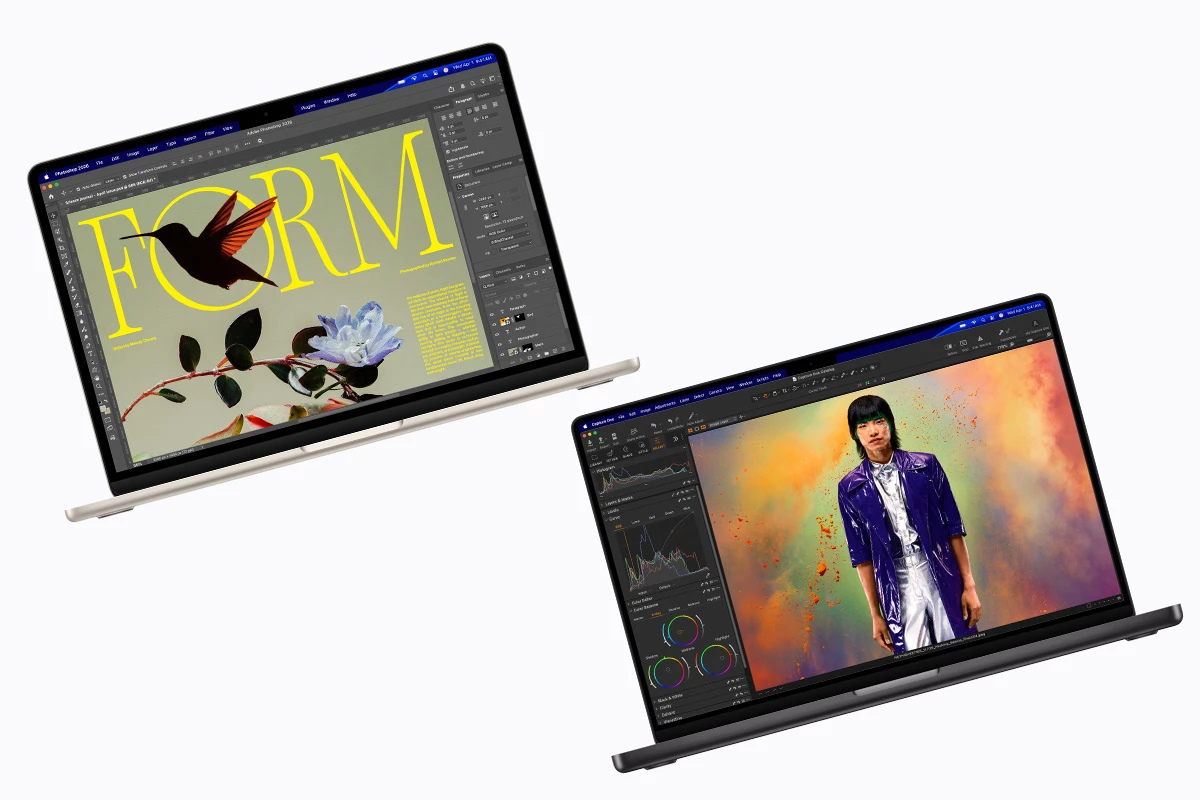



The new MacBook Air and MacBook Pro are great for most people and for demanding users respectively – but as much as Apple has raised the bar with these, they're just incremental improvements that aren't worth upgrading from the previous models.
That's Apple's fault – and it's not entirely a bad thing. The company has been making excellent laptops based on its own chips with stellar performance and class-leading battery life for a while now, so it's hard to make the case for getting the latest one in 2026 if you have a laptop that's a year or even three years old.
In any case, the new Air and Pro have powerful new componentry that make them compelling for folks upgrading from substantially older devices or simply getting a spanking new laptop. Here's a quick look at what's inside, and how they're different from the M4 hardware from mid-2024.
MacBook Air
This is Apple's super portable model that's available in 13- and 15-inch sizes. It gets the M5 chip, which came out last October and first appeared in the 14-inch MacBook Pro and iPad Pro from 2025. Despite being the more lightweight option, it's no slouch, and will easily blaze through all kinds of everyday workflows involving browsers, productivity apps, and even intermediate photo, audio and video editing.

For 2026, you can get the Air with up to a 10-core CPU and 10-core GPU. Apple's upgraded the base storage to a roomy 512 GB, and 16 GB of RAM comes standard. It's worth noting this SSD storage is roughly twice as fast than that on the M4-based Air, so moving large files around and opening them should feel snappier.
The new Air gets higher bandwidth unified memory that's 28% faster than with the M4, so you could potentially see some benefits while multitasking. That's certainly not a bad thing, but you already have to go pretty hard to tax an M4 with most apps. So it'll really be a significant upgrade only for people coming from an Intel- or M1-based Air.
You'll also get a new N1 chip, which brings faster connectivity with Wi-Fi 7 and Bluetooth 6 – but you'll need a high-speed internet plan and a recent router to really take advantage of that.
That's mostly all that's new. You'll get the same two Thunderbolt 4 ports for charging and data transfer, with the ability to power two external displays as with the M4-based Air. The notched display and battery life remain the same, as does the design that's remained unchanged since the M2 from 2022. All this comes in at a starting price of US$1,099 – a $200 jump from the last model.
MacBook Pro
This is the workhorse from Apple's stable, available in 14- and 16-inch variants with loads of options to configure the internals. It's best suited to high-level video editing, VFX work, 3D modeling and rendering, composing scores, and working with custom AI models.
The big deal with the Pro is you can get it with the powerful new M5 Pro and M5 Max chips. These are made using a new dual-die 3-nm Fusion Architecture that promises high bandwidth and low latency. It allows for up to 18 cores for the CPU, and up to 20 and 40 cores for the GPU on the Pro and Max respectively. Apple says these deliver up to a 50% quicker graphics performance compared to the M4 Pro and M4 Max in 3D and VFX applications.
Additionally, each of those GPU cores gets a Neural Accelerator, which allows for up to 4x faster performance using AI-driven features like training LLMs, and generating video, visual effects, and music. The 128 GB of unified memory (64 GB on the Pro) with a max bandwidth of 614 GB/s (307 GB/s on the Pro) helps with on-device AI performance as well.
Storage capacity starts at 1 TB on the Pro, and 2 TB on the Max, and you can get as much as 8 TB of the faster new SSDs in these. You'll also get Thunderbolt 5 ports and the ability to run four external displays. These models promise 24 hours of battery life, with 140-W charging on the 16-inchers with either chip, and 96-W charging on the 14-inch models.

Other than that, Apple hasn't bothered to update the MacBook Pro's external design. You're also going to see the same camera, display, mic and speakers as on the outgoing models.
For 2026, the MacBook Pro starts at $2,199 - a $200 bump from the previous M4 Pro's entry point. The 16-inch M5 Max will set you back by $3,900, before you begin tacking on additional storage and other goodies.
As with the Air, the latest MacBook Pro makes sense if you're upgrading from a machine that's a few years old and is holding up your work owing to long loading or rendering times – or if you plan to work extensively with local AI models.
If you're indeed in the market for a laptop, hold off at least until tomorrow, when a 'MacBook Neo' is slated to arrive at an affordable price point. That'll give you more options to consider. And if you don't need something right away, it's worth noting that we heard rumors last December of an M6-powered MacBook Pro with a new external design scheduled for release later in 2026.
Mind you, this isn't going to be an M6 Pro or M6 Max, so that's worth keeping in mind if you need blazing fast performance – in which case, the M5 Pro and M5 Max MacBook Pros will get the job done. The M5-equipped MacBook Pro is also still available, with a starting price of $1,699.
Pre-orders for these new models open on Apple's site on March 4, and they'll begin shipping by March 11. Check out the MacBook Air and the MacBook Pro on the company's site.